


Color of the coat, skin, and eyes in dogs originates from specific skin cells called melanocytes, which produce the pigment melanin. The basic color of the coat is determined by two basic melanin pigments – black eumelanin and yellow-red pheomelanin. Several genetic loci are known to be responsible for the basic color and other color patterns of the coat in dogs, among which the E, K, and A loci play a key role. These three loci determine whether melanocytes will produce black or yellow-red pigment. Different combinations of alleles at these three basic loci and the remaining color loci determine the exact color of a dog's coat. Genetic tests can identify specific variants of alleles at color loci and thus identify the presence of hidden, recessive colors that a dog does not express phenotypically (they are not visible on the coat).
E locus allows the production of black pigment and the expression of all the other color loci when the dominant normal alleles are present at the locus. Due to the dominance of the E allele, only one copy is sufficient for its expression, and dogs with the genotypes E/E and E/e will normally express the other color loci. When the recessive e alleles are present at the locus (genotype e1–3/e1–3), the affected dog expresses a uniform yellow-red color, which simultaneously disables the expression of K and A loci and allows the expression of I locus. The I locus, in the recessive state (genotype i/i), affects the dilution of the yellow-red color. The E and I loci in dogs with the genotypes e/e and i/i do not affect the synthesis of pigment in the nose, pads, and eyes, the color of which depends on the state of the alleles at the B locus. An additional six alleles have recently been discovered at the E locus that affect the basic coat color – these are alleles with the hierarchy EM > E > eA/eH/eG > e1–3. In the recessive state, the e2 allele (genotype e2/e2), which is found in the Australian Cattle Dog, leads to the inability to form black pigment, resulting in a cream-colored coat. The e3 allele, which is found in Alaskan and Siberian Huskies, is responsible for an almost completely white coat (pale yellow), with genotypes e3/ e3 or as compound heterozygotes (e1/e3). The eH allele is found in the Cocker Spaniel and is responsible for the coat pattern called sable. To express the eH allele, a dog must have the genotype eH/eH or eH/e1–3, in the absence of dominant alleles at the EM and E loci. The eA allele, which is found in most dog breeds, in the absence of dominant alleles EM and E, causes coat patterns called domino (Alaskan Malamute, Spitz), grizzle (Chihuahua), and pied (Beagle). Unlike other alleles at the E locus, the eA variant increases the expression of yellow-red pigment (reducing the effect of the K locus in dogs with a dominant black coat), but still allows minimal expression of black pigment, which is manifested in the coat as individual black hairs. The final effect of the eA allele on coat color depends on the state of the alleles at the K and A loci – the color patterns determined by the A allele are thus slightly lighter due to the eA variant. The eG variant, which is found in the Afghan Hound, Saluki, Borzoi, and Polish Hound, acts in a similar way. In the absence of dominant alleles at the EM and E loci, the genotypes eG/eG and eG/e1–3 result in coat patterns called grizzle or domino.
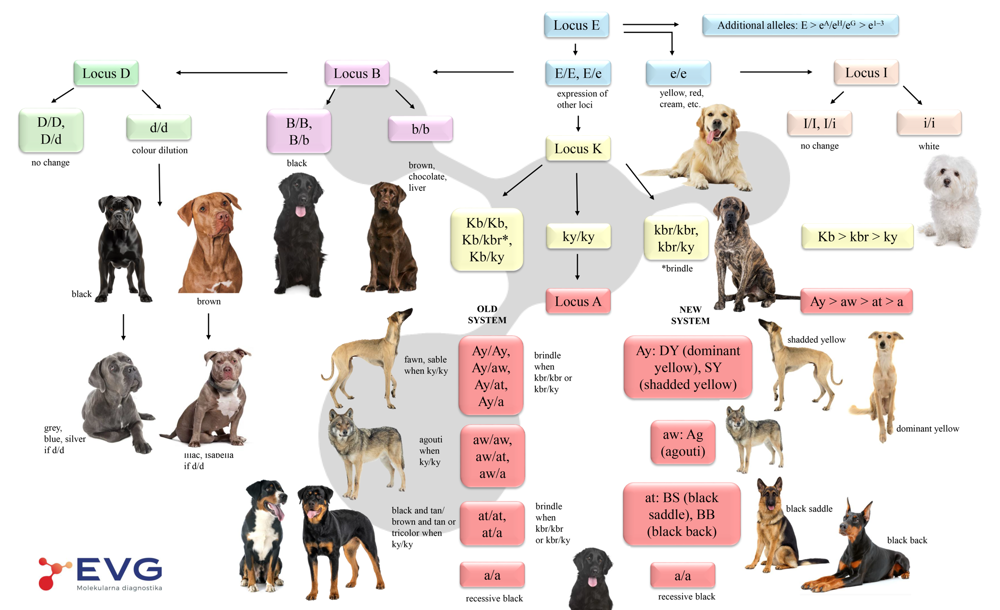
K locus plays a major role in regulating color formation, as it is involved in switching between the production of both melanin pigments, in addition to the A locus. Its expression depends on the state of the alleles at the E locus. In the case of the e/e genotype at the E locus, the K locus is not expressed – it has no effect on color. Three different alleles have been described at the K locus, with the following dominance hierarchy: KB (dominant black) > kbr (brindle) > ky (normal color or no effect on color expression). If at least one dominant KB allele is present (genotype KB/*), this allele will be expressed. The KB allele is responsible for a solid-colored coat in pigmented areas. The kbr allele is responsible for the formation of brindle fur in the kbr/kbr or kbr/ky genotype, which is characterized by the presence of black stripes in areas that are otherwise light to dark yellow-brown (fawn). The color of the stripes depends on the state of the alleles at the B and D loci. The ky allele is a normal (wild type) allele without a mutation, which has no effect on color expression and leaves the regulation entirely to the A locus (agouti). K locus is dominant over the A locus and thus determines whether the dog will express the colors determined by the A locus. For the A locus to determine coat color in each dog, the dog must not carry the dominant black allele (genotype KB/KB or KB/n) at the K locus, nor the e/e genotype at the E locus. In dogs that can express the A locus, the basic color can still be modified by the B and D loci.
A locus is responsible for different coat color patterns. In dogs, there are four different alleles at the A locus with the following dominance hierarchy: Ay > aw > at > a, which means that the most dominant allele will be expressed. The Ay allele determines a dominant light to dark yellow-brown color, with or without black hair tips or individual black hairs (fawn or sable). The aw allele causes switching between the synthesis of eumelanin and pheomelanin, resulting in hairs that are banded with darker and lighter coloration from base to tip (wild color – agouti). A dog will express this coloration when the A locus has the genotype aw/aw, aw/at, or aw/a. The at allele is responsible for black-and-tan or tricolor coat coloration. Black-and-tan dogs are basically black with brown pheomelanin areas on the belly, legs, cheeks, and as spots above the eyebrows (Doberman and Rottweiler). Tricolor dogs have white in addition to black and tan, which is the result of the absence of pigment in certain areas of the body (Collie). The amount and distribution of pheomelanin vary among individual dogs and between breeds. A dog that has the genotype at/at or at/a will be black and tan or tricolor. The a allele is the least common allele at the A locus and is responsible for recessive black or bicolor coat color. Since the a allele is the most recessive allele at the A locus, a dog must have two copies of this allele for it to be expressed. A dog with the genotype a/a will always pass the a allele to its offspring. In cases where the dog does not have black fur, genetic testing can determine whether it is a carrier of the recessive black allele. With classical genetic analysis, it was not possible to distinguish whether a dog with the genotype Ay/Ay has dark hair tips (shaded sable) or not (clear sable). It was also not possible to determine whether a dog with the genotype at/at or at/a is black-and-tan or saddle tan. With advanced genetic testing, several genotypes at the A locus can be distinguished based on specific gene regions: DY (old system: Ay – dominant yellow), SY (old system: Ay – shaded yellow), AG (old system: aw – agouti), BS (old system: at – black saddle/saddle tan), BB (old system: at – black-and-tan/black back), and a (recessive black). The genotype is determined by variations in two different regulatory regions of the genes—the ventral promoters (VP), in two variants, control the distribution of black pigment throughout the dog's body, while the hair cycle promoters (HCP), in five variants, control the distribution of black pigment along each hair. Different combinations of VP and HCP lead to several haplotypes that determine the allelic variant at the A locus. It should be noted that different haplotypes can lead to the same phenotype, but not necessarily the same genotype.
B locus is responsible for changing the coat color from black to brown, but it does not affect yellow-red pigment, as the mutation for brown color only affects dogs that are capable of producing black pigment – they must have at least one normal E allele at the E locus (genotype E/E or E/e). In addition to coat color, the B locus also affects the color of the nose, pads, and eyes, which is independent of the state of the alleles at the E locus. Dogs with the genotype e/e produce only yellow-red pigment in the coat but still produce black pigment in the nose, pads, and eyes, which means that the B locus can affect them. Chocolate color is inherited recessively at the B locus, while black color is dominant. In addition to the normal dominant allele B, three more recessive alleles have been described at the B locus, namely bc, bs, and bd. The presence of two copies of any of these recessive alleles (bc/bc, bd/bd, or bs/bs) results in a brown coat. If a dog carries different recessive alleles (bc/bd, bc/bs, or bd/bs), it may also have a brown coat if it has inherited recessive alleles from both parents; in such cases, both parents should be tested for more accurate results. However, if the dog is black, genetic testing can determine whether the black color is due to the A locus (genotype a/a, recessive black) or the B locus (genotype B/B or B/b, dominant black), depending on the state of the alleles at the K locus. Currently, three dog breeds have additional alleles at the B locus: in Australian Shepherds, the baus allele; in Siberian Huskies, the bh allele; and in Lancashire Terriers, the be allele. The cocoa color in French Bulldogs is caused by dominant alleles at the Cocoa locus. Compared to the brown coat color determined by the B locus, the Cocoa locus results in a slightly darker brown coat and lighter eyes.
In addition to the color loci, there are several other loci that affect the amount of pigment produced, as well as the shade and distribution of color throughout the body. The D locus is responsible for the formation of a diluted coat color (d/d) affecting the dog's fur, nose, pads, and eyes, and it influences both black and yellow-red pigment. For example, black dogs in the recessive state at the D locus (d/d) appear gray or blue, while brown dogs appear lilac or isabella.
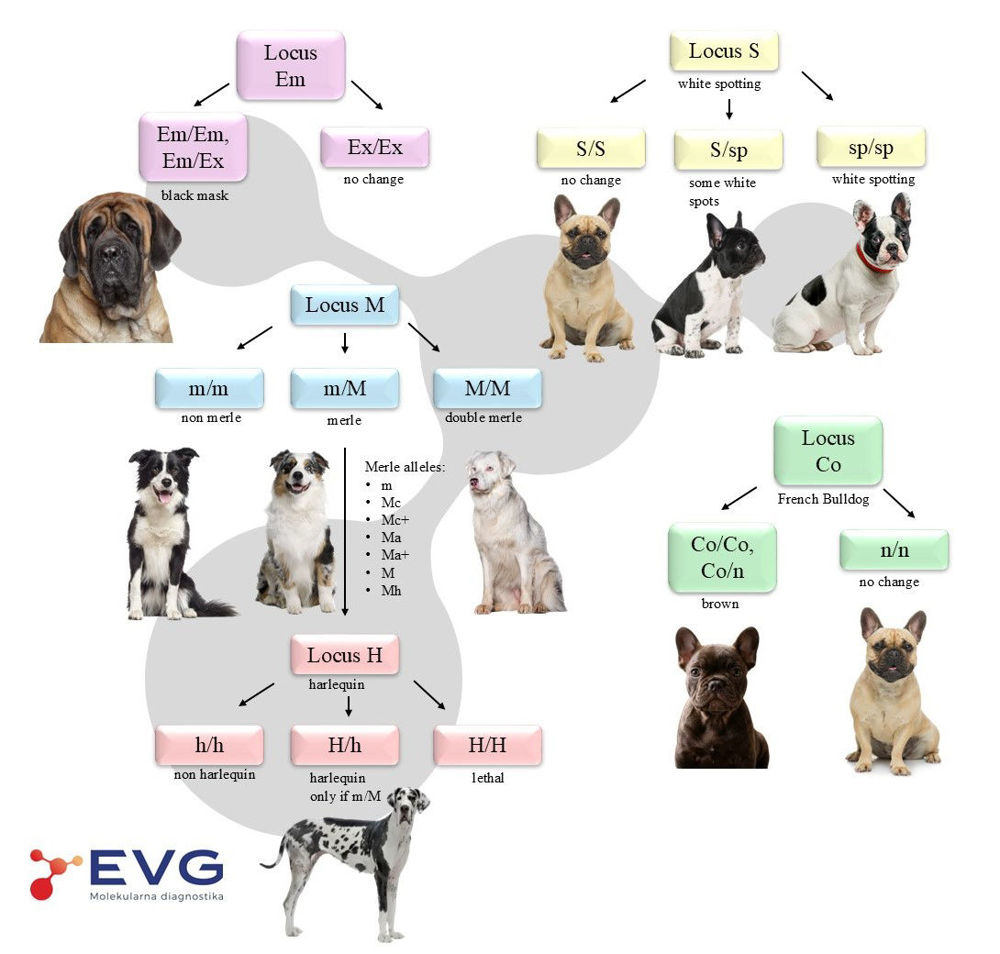
The S locus in dogs is responsible for white coat patterning, which varies in the amount of white between breeds and among individuals within a breed. Dogs with the genotype S/S will not express white, while dogs with the genotype sp/sp will have white markings that may cover only the ventral surface or most of the body (spotted or almost completely white dogs). Most dogs that are heterozygous at the S locus (genotype S/sp) are solid-colored or have minimal white, for example on the toes.
The EM locus is responsible for the formation of a black mask, which in the dominant state (genotypes EM/EM and EM/Ex) causes the production of black pigment in the muzzle and ear areas. The mask is only visible in dogs with light-colored coats without black tipping. In dogs that are white, black, brown, or gray, the mask does not differ in color from the rest of the coat, despite the presence of the EM allele – such dogs can still pass this allele on to their offspring.
In many dog breeds, a characteristic marbled coat pattern can be observed, with irregularly shaped, randomly discolored areas. This pattern is the result of a mutation at the M locus, which is inherited in an autosomal dominant manner. The mutation interferes with the formation of black pigment, so it is phenotypically expressed only in dark pigment and is visible in black, brown, blue, and isabella-colored coats. The resulting color pattern is called merle and includes changes in the color of the eyes, nose, pads, and skin. The M locus has no effect on red pigment, so dogs with the e/e genotype do not show the merle coat pattern, although they may have blue eyes – this is referred to as hidden merle, which can be passed on to offspring. A special feature of the M locus is its susceptibility to mutation, which can result in mosaic coat coloration. Mosaicism refers to the presence of allele variants of different lengths in different cells of the dog's body. In practice, this means that not all cells in the body carry identical genetic information at this locus, which is phenotypically manifested as uneven, asymmetrical, and variably colored fur. In addition to coat color, this mutation is also important from a health perspective, as it plays a significant biological role in hearing and vision impairment in dogs with the M/M genotype at the M locus (double merle). It is assumed that the presence of sufficiently long merle alleles leads to the loss of pigment cells in the skin, retina, and inner ear, resulting in a predominantly white coat and associated hearing and vision problems.
In connection with the M locus, the H locus (harlequin) acts, and is expressed only in the presence of the dominant M allele – dogs without the merle pattern do not express the harlequin phenotype. Care must be taken when breeding, as dogs with the HH genotype are not viable*https://www.eurovetgene.com/h-lokus-harlequin. Dogs that express both merle and harlequin have distinct, unevenly distributed black spots on a white coat. The M locus is responsible for the discolored areas on a dark background, while the H locus converts the gray areas, resulting from the M locus, into white.